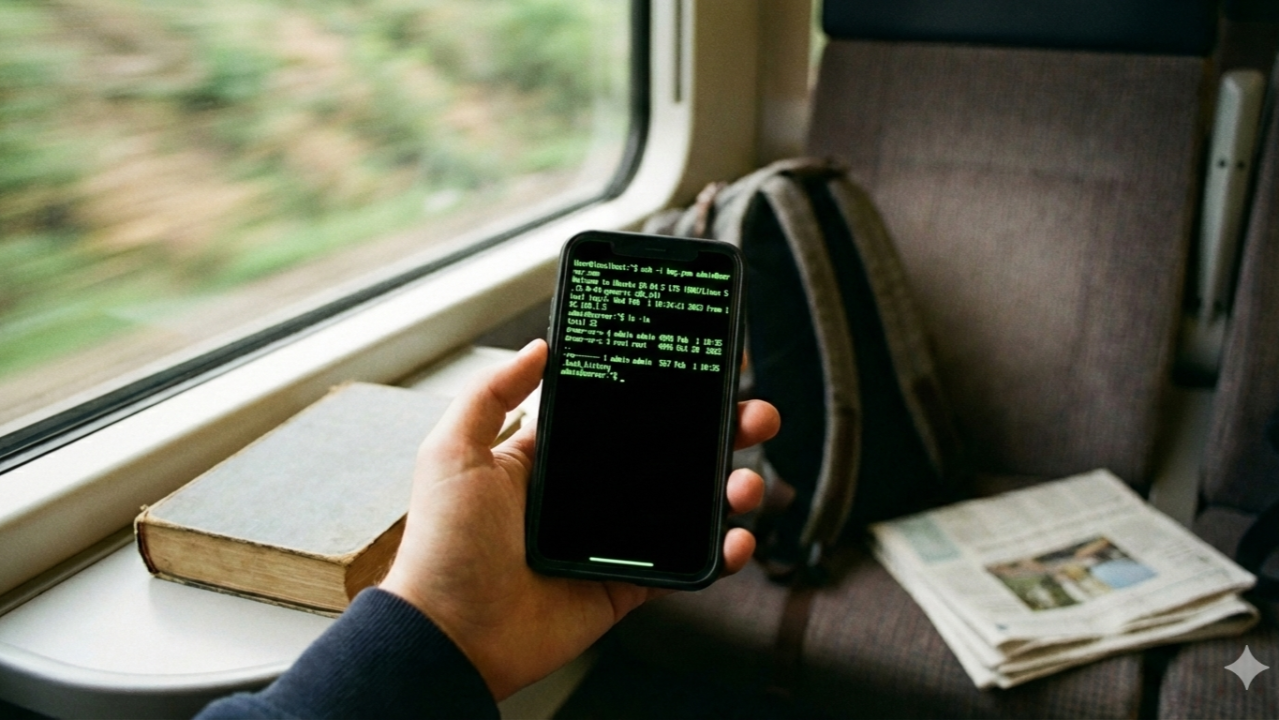
Saturday morning, I’m on a train with a newspaper and a book next to me - I specifically didn’t bring my laptop so I wouldn’t work this weekend. But I’m already working, on my phone, deep in a chat with an AI.
I don’t even remember the moment I switched, one second I was planning to read, the next I was “just checking” how my prompt training is progressing - no transition, no conscious choice, just that familiar flow.
For a few minutes I felt good about it: “Look at me, I’m being productive, getting ahead on next week”. Then I realized I wasn’t actually working, I was just scratching an itch.
In the past I could lose hours to games or mindless scrolling, and I knew exactly what that was: entertainment, a simple dopamine loop of Input, Action, Reward. Sitting there on the train I realized I hadn’t actually grown out of that loop, I had just swapped the interface: traded the game controller for a chat window, traded the “Level Up” screen for a generated strategy, traded Doomscrolling for Doomprompting.
The Perfect Camouflage
This new loop is a lot more dangerous than social media ever was. When you play a game for five hours straight you feel the guilt, you know you “wasted” time, but when you spend five hours prompting an AI to refine a document - tweaking instructions, regenerating output, asking for one more variation - you feel virtuous, telling yourself you’re being thorough, thinking you’re optimizing.
But are you? Or are you just chasing the “Slot Machine” effect?
The mechanism is exactly like Instagram: you pull the lever (write a prompt), wait those few seconds of anticipation, andding- the reward appears, a perfectly formatted response, a clever solution, a block of text. It’s the same immediate hit as a “Like” notification, but since the output looks like “work” the internal alarm bells never go off. We’ve gamified our own jobs and we didn’t even notice.
The Cost of Passive Acceptance
This isn’t just a hunch - the data is starting to show what this does to our brains. A recent study from Anthropic (January 2026) tracked how people learn with AI assistance and found a huge difference between two specific behaviors.
The first is Active Engagement: you think through the problem first, use AI to execute, then verify the result - this actually works. The second is Passive Acceptance: you let the AI lead, accept the output because it looks professional, let the tool do the thinking.
The researchers found that Passive Acceptance leads to skill degradation: people felt faster but were actually learning less, and six months later they couldn’t do the same task without the AI. This is exactly what “Doomprompting” looks like.
When I’m mindlessly prompting on the train I’m not doing Deep Work, not wrestling with the hard stuff - I’m just letting the AI drive because it feels good to see the text appear. I’m feeling productive (high velocity) but I’m actually stalling (low value).
The Productivity Paradox
This explains the weird disconnect we’re seeing in tech right now: most managers report feeling 20-24% faster with AI, but objective measurements - like the METR study from late January - show that for complex work we are often slower.
Why? Because we’re spending all our time managing the tool instead of solving the problem, debugging prompts instead of debugging logic, reviewing five variations of a strategy instead of just picking one and executing.
Turns out we’ve replaced the difficult, quiet work of thinking with the fast, loud, exciting work of generating.
Reclaiming the Quiet
I’m not going to stop using AI - I use it every day, it’s the most powerful tool I’ve ever had. But I’m realizing I have to treat it with the same caution I use for social media: it’s a high-dopamine environment specifically designed to keep you engaged.
If I can’t sit on a train for an hour with just my own thoughts, without reaching for the “Slot Machine” to generate something, that’s not productivity - that’s a dependency.
So I finally put the phone away and picked up the book. It was slower, a lot quieter, no flashing cursors or instant answers. And for the first time in a week I actually started thinking.
What about you?
Have you caught yourself “Doomprompting”? Do you ever spend an hour refining prompts for something you could have done yourself in twenty minutes?
Let’s be honest about it.