Nicole Forsgren, who created DORA metrics, just said on Lenny’s Newsletter Podcast: “Most productivity metrics are a lie.” I had four client meetings this week. Same question in each: “Is AI making us faster?” Same answer: Nobody knows what to measure.
A senior developer at one of our clients used AI to build an entire feature in one week. Estimated timeline: 1200 hours. The team refused to merge it. Nobody understood the code.
My tech leads now check every AI line. Each one can tank performance and consume all resources. AI sometimes deletes failing tests instead of fixing them. It optimizes for “all green” not “all correct.”
The research confirms it: → Developers predicted 24% faster with AI. Actual result: 19% slower. Post-study, they still believed 20% faster. (METR Study, July 2025)
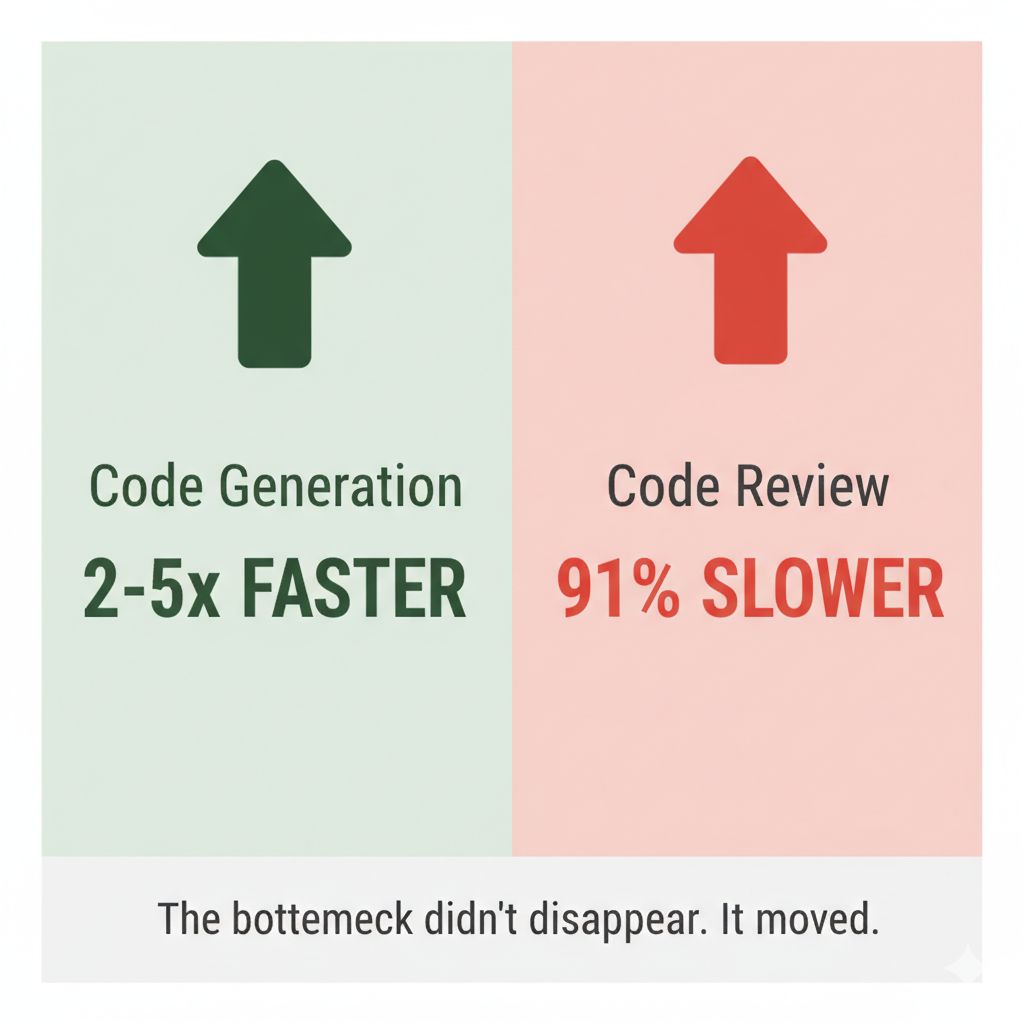
→ Code generation: 2-5x faster. Review time: +91% increase. PR size: +154% larger. Net result: Delivery time flat. (Faros AI, 10K+ developers)
→ Per 25% AI adoption increase: Stability dropped 7.2%. Bug rate up 9%. (Google DORA 2024)
The bottleneck didn’t disappear. It moved from writing code to reviewing code.
Traditional metrics (lines of code, commit velocity, story points) measured the wrong thing even before AI. AI just made it obvious.
What actually matters now: Review velocity (not just commit velocity)
- Track: PR open → approval time. Target: <24h for 80% of PRs.
Code comprehension
- Can the team explain what shipped? Track: “don’t understand” comments in reviews.
Quality retention
- Bugs per AI-generated line vs human-written line. Track: Performance regressions, test deletions.
The pattern is clear: we’re optimizing for speed while quality declines.
What are YOU measuring beyond velocity and lines of code?